

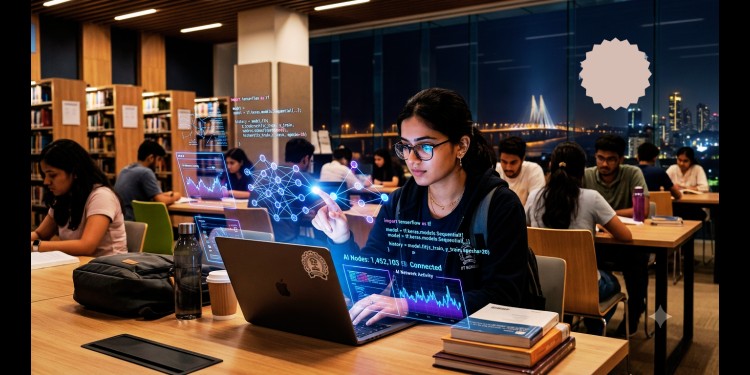
AI Literacy: An Opportunity or a Challenge for Students’ Academic Progress?
In today’s tech-savvy era, Artificial Intelligence (AI) is rapidly becoming an integral part of students’ academic lives. College students are increasingly using various Generative AI tools to support their academic work. From assignments and presentations to research, information gathering, translation, writing and problem-solving, the use of AI in education is expanding at a remarkable pace.
While AI offers speed, convenience and access to information, its growing presence in higher education has also raised an important question: Is AI literacy an opportunity for students’ academic progress, or is it becoming a challenge to their independent learning and critical-thinking abilities?
Against this backdrop, while conducting research on the topic “Artificial Intelligence (AI) Literacy among College Students and Its Impact on Academic Performance: A Study of Generative AI Tools,” an attempt was made to understand the perspectives of faculty members from different educational institutions regarding the increasing use of AI by students.
Prof. Ahmed Ali, currently working as an IT faculty member at Guru Nanak College, GTB Nagar, views AI literacy as both an opportunity and an instructional challenge.

According to him, “AI literacy is a transformative opportunity wrapped in instructional challenges: it empowers students with personalized tutoring, faster ideation, and essential workplace skills, but risks weakening critical thinking if overused as a shortcut. The faculty mandate isn’t to ban AI, but to teach students how to audit, critique, and think with technology rather than letting it think for them.”
His observation highlights an important reality of modern education. The challenge is not simply whether students should use AI, but whether they understand how to use it critically and responsibly. AI can assist the learning process, but students must retain the ability to question, analyse and independently evaluate the information generated by technology.
However, concerns about the impact of AI on traditional learning practices and academic integrity remain equally significant.
Bhagyshree Kamtekar, a faculty member at Universal MSG SGKM College of Arts, Science and Commerce, expresses concern about students becoming excessively dependent on automated content.

In her words, “As a faculty member, I view the push for AI literacy as a significant challenge to traditional academic integrity and skill development. When students rely on automated output, they miss out on developing the vital analytical writing and independent reasoning skills that higher education exists to cultivate.”
Her perspective draws attention to one of the most important challenges facing higher education today. If students begin treating AI-generated answers as substitutes for their own academic effort, the very purpose of education—developing independent thinking, analytical abilities and original expression—could be affected.
At the same time, AI literacy also presents significant opportunities when technology is used as a learning aid rather than a replacement for human effort.
Sanjay Suresh Pandav, Principal of Namrata Acharya English School and Junior College, Shelu, believes that AI can contribute positively to students’ learning and creativity when used responsibly.

According to him, “AI literacy is a great opportunity for students to enhance learning, creativity, and problem-solving skills. However, it should be used responsibly as a learning aid, not as a substitute for critical thinking, originality, and independent effort.”
These faculty perspectives reveal a common thread: AI itself is neither the complete solution nor the problem. What matters most is how students understand and use it.
Generative AI has the potential to support academic learning, research and creativity, but excessive dependence on it can affect originality, analytical writing, independent reasoning and critical thinking. Therefore, AI literacy must go beyond simply knowing how to use an AI tool. Students also need to understand how to verify AI-generated information, question its accuracy, recognise its limitations and use it ethically in academic work.
In conclusion, the responses of faculty members make one point particularly clear: AI can be an effective and useful educational tool, but it cannot replace human intelligence.
When AI is used responsibly, ethically and with a critical mindset, it can contribute to improving students’ academic quality, research capabilities and creativity. At the same time, educators have an important role in ensuring that technology strengthens rather than replaces students’ independent intellectual abilities.
As Generative AI continues to reshape the educational environment, incorporating AI literacy as an integral part of the higher education curriculum is increasingly becoming the need of the hour. The future of education may not be about choosing between human intelligence and artificial intelligence, but about teaching students how to use technology intelligently while preserving originality, curiosity and independent thought.
Compiled by: Shubham Rekha Shankar Pedamkar
Note: Photo of the student is AI generated